Summary:
You’ve invested in a pool for your family to enjoy. But the moment that water goes in, a new responsibility kicks in—keeping your kids safe around it. Glass pool enclosures look stunning, sure. But are they actually safe? Can a child break through them? Do they meet New York’s strict pool codes?
These aren’t just casual questions. They’re the ones that keep you up at night, especially if you have young children or pets. You want a barrier that protects your family without turning your backyard into a fortress. You want something that looks good, functions well, and meets every legal requirement without guesswork.
Let’s walk through the five most common safety and compliance questions families in Nassau and Suffolk County ask about glass pool enclosures—and give you real, useful answers.
Is Tempered Glass Strong Enough to Keep Children Safe?
This is usually the first question on every parent’s mind. Glass sounds fragile. You picture a child running into it, a ball hitting it, or someone leaning too hard against it. So how strong is it really?
The glass used in pool enclosures isn’t regular window glass. It’s tempered safety glass, and the difference is significant. Tempered glass is heated to over 1,000 degrees and then rapidly cooled, which makes it four to five times stronger than standard glass. That means it can handle impact, pressure, and daily wear far better than what you’d find in a typical window.
If you’re worried about a child breaking through, here’s what matters: properly installed tempered glass panels for pool fencing can withstand over 200 pounds of pressure per square inch. A child running into it, leaning on it, or even throwing a toy at it isn’t going to cause a failure.

What Happens If Tempered Glass Breaks Around a Pool?
Even the strongest materials can break under extreme force. So what happens if tempered glass does fail? This is where the safety design really shows up.
When tempered glass breaks, it doesn’t shatter into long, sharp shards like regular glass. Instead, it crumbles into small, blunt pieces—kind of like the way a car windshield breaks. Those pieces are far less likely to cause serious cuts or injuries. That’s the whole point of using tempered glass in areas where people are active, like pools, showers, and doors.
Building codes actually require this. In New York, any glass installed within 60 inches of a pool area must be safety glazing—either tempered or laminated. That’s not a suggestion. It’s the law, and it exists specifically to reduce the risk of injury if something goes wrong.
Now, does that mean you should expect your glass pool enclosure to break? Not at all. When it’s properly installed and maintained, tempered glass is incredibly durable. But it’s reassuring to know that even in a worst-case scenario, the material itself is designed to minimize harm.
You should also know that professional installation matters here. Glass panels need to be anchored correctly, with the right hardware and spacing. Poorly installed glass can shift, crack, or fail prematurely. That’s why working with experienced installers who understand both the material and the local codes is critical. You’re not just buying glass panels. You’re buying a complete pool safety system that’s engineered to stay secure under real-world conditions, from summer pool parties to Long Island’s winter freeze-thaw cycles.
Can Children Climb Glass Pool Fences?
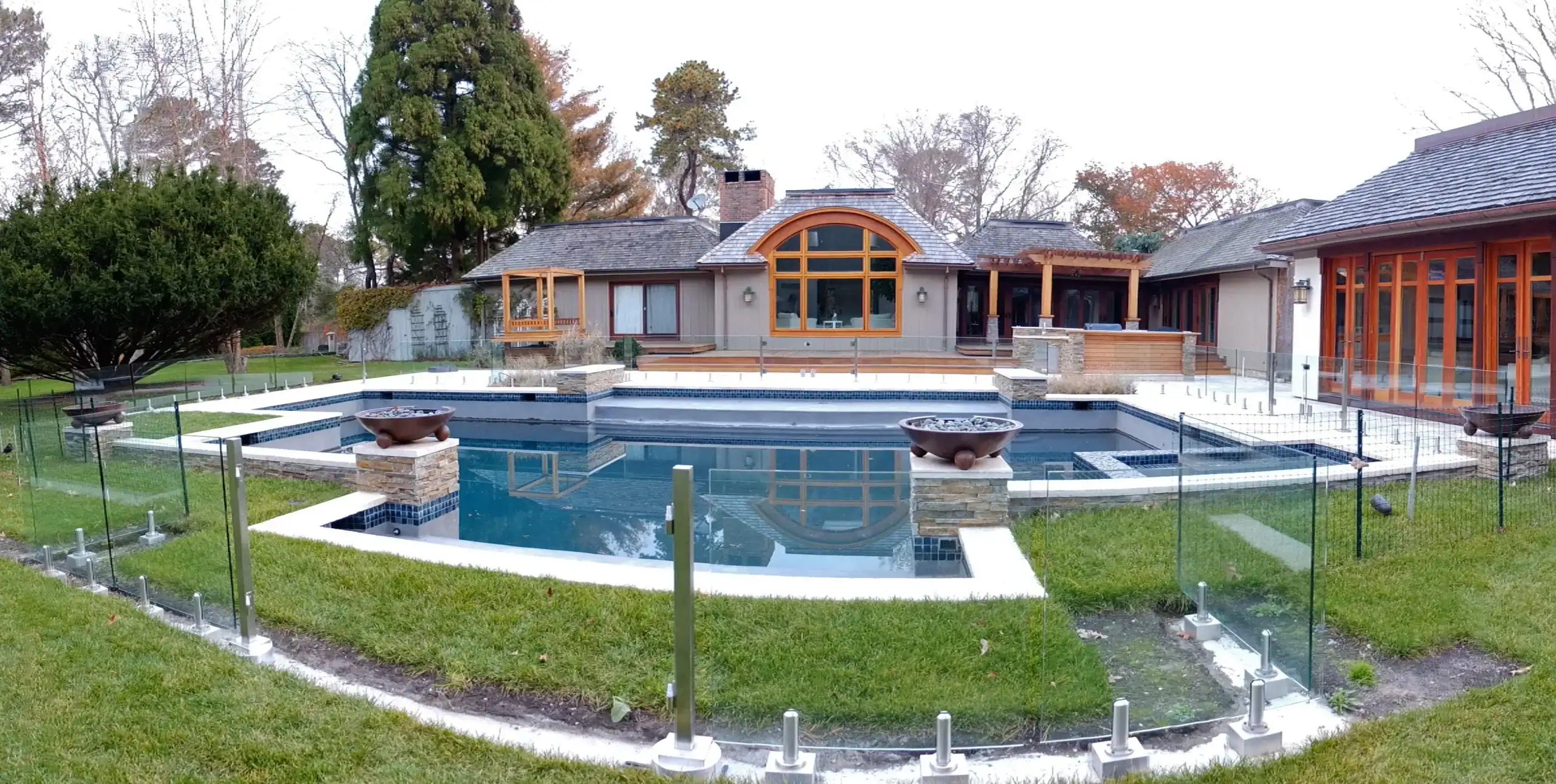
One of the biggest advantages of glass pool enclosures is that they’re nearly impossible for children to climb. Unlike chain-link fences, wooden slats, or wrought iron with horizontal bars, glass panels don’t offer any footholds. There’s nothing for little hands to grab onto, nothing to step on, and no way to hoist themselves up.
This is a huge safety benefit. According to data from the Consumer Product Safety Commission, one in ten child drownings in pools happens when a child figures out how to get through or around a pool fence. Kids are clever. They’re determined. And if there’s a way to climb something, they’ll find it.
Glass eliminates that risk. The smooth surface provides no leverage. Even older, more coordinated children can’t scale it the way they might with other types of fencing. That’s one of the reasons glass pool fencing has become so popular among families with young kids across Nassau and Suffolk County.
But here’s the other part that matters: visibility. With a glass barrier, you can see your entire pool area from inside your home or from anywhere in your yard. You’re not trying to peek through slats or around posts. You have a clear, unobstructed view at all times. That means if a child does wander toward the pool, you’ll see them immediately.
That visibility is more than just convenient. It’s a critical layer of protection. Drowning happens fast and quietly. You don’t always hear splashing or yelling. Being able to see the pool area clearly gives you the chance to respond before something goes wrong. And when you pair that visibility with a barrier that can’t be climbed, you’ve created a much safer environment for your family.
Do Glass Pool Enclosures Meet New York Building Codes?
New York doesn’t mess around when it comes to pool safety. The state has specific, enforceable requirements for any pool barrier, and glass enclosures need to meet every one of them. If you’re in Nassau or Suffolk County, you’re also dealing with local codes and permitting processes that can vary by town.
So yes, glass pool enclosures can absolutely meet New York building codes—but only if they’re designed and installed correctly. The key is understanding what those codes actually require and making sure your installation checks every box.

New York Pool Barrier Requirements for Glass Enclosures
New York State Residential Code Section R326 lays out the rules for pool barriers. These apply to any pool that holds water more than 24 inches deep, which includes most inground and many above-ground pools. Here’s what the code requires.
Your barrier must be at least 48 inches tall. That’s four feet, measured from the ground to the top of the fence or enclosure. This height standard is designed to prevent young children from easily reaching over or climbing the barrier. Glass pool enclosures typically meet this requirement with panels that stand 54 to 60 inches high, providing extra safety margin beyond the minimum.
The barrier also can’t have any openings that allow a sphere four inches in diameter to pass through. That’s roughly the size of a young child’s head or torso. This rule prevents kids from squeezing through gaps or getting stuck. With glass panels, this is easy to achieve since there are no gaps between vertical slats or horizontal bars—just solid, continuous glass.
There’s also a ground clearance rule. The space between the bottom of your barrier and the ground can’t exceed two inches. This prevents children or pets from crawling underneath. Glass enclosures meet this requirement through proper installation and base mounting systems that sit flush to your pool deck or patio.
Gates are another critical piece. Any gate that provides access to the pool must be self-closing and self-latching. The latch must be positioned at least 54 inches above the ground, or on the pool side of the gate, to keep it out of reach of young children. And the gate must swing outward, away from the pool, so a child can’t push it open.
If your house serves as part of the pool barrier—meaning there’s a door that opens directly to the pool area—that door must either be equipped with an alarm or the pool must have a powered safety cover. This ensures that if someone exits the house toward the pool, you’re immediately notified.
All of these requirements exist for one reason: to prevent unsupervised access to the pool by young children. And glass pool enclosures, when properly designed, meet every single one of these standards while providing superior visibility and a modern aesthetic.
Nassau and Suffolk County Pool Enclosure Permit Requirements
State codes set the baseline, but Nassau and Suffolk Counties—and individual towns within them—often have their own permitting requirements and inspections. Some towns require permits for any pool barrier installation. Others have specific setback requirements that dictate how far your enclosure must be from property lines. Understanding these local regulations is essential before you start any pool enclosure project.
For example, some Long Island municipalities require pool fences to be at least five feet tall, exceeding the state’s four-foot minimum. Others have stricter rules about gate hardware, latch placement, or alarm systems. And nearly all require a final inspection before you’re allowed to use your pool. Towns like Hempstead, Oyster Bay, Smithtown, and Southampton each have their own specific codes and fee structures.
This is where working with a local installer makes a real difference. We’ve been installing glass pool enclosures in Nassau and Suffolk County for over 20 years, so we know which towns require what. We know how to navigate the permit process, what documentation you’ll need, and how to schedule inspections without delays. We understand the soil conditions across Long Island too—from the rockier terrain in some Nassau County areas to the sandier ground near the Suffolk County coastline—and how those conditions affect installation.
Trying to DIY this or hiring someone unfamiliar with Long Island’s requirements can lead to failed inspections, fines, or costly rework. Worse, it can leave you with a barrier that doesn’t actually protect your family the way it should. You might pass the visual test but fail on technical requirements like latch height, ground clearance, or glass thickness specifications.
A compliant glass pool enclosure isn’t just about avoiding penalties. It’s about ensuring your barrier does its job. When your installation meets or exceeds all applicable codes, you can trust that it’s been designed with safety as the priority. And when it passes inspection, you have proof that it’s been installed correctly. You also protect your insurance coverage—many homeowner policies require code-compliant pool barriers, and a failed inspection could leave you exposed if an accident occurs.
Making the Right Choice for Your Family's Pool Safety
Glass pool enclosures are safe, compliant, and effective when they’re designed and installed the right way. Tempered safety glass is strong enough to withstand daily use and impact. It can’t be climbed by children. It provides clear visibility for supervision. And it meets New York’s strict building codes when installed to spec.
But the quality of your installation matters just as much as the material itself. You need a barrier that’s anchored properly, built to local code, and inspected by professionals who understand Long Island’s requirements. You need gates that latch correctly, glass that’s the right thickness, and hardware that’s rated for outdoor use.
At OMG Shower Doors, we bring over 20 years of experience designing and installing custom glass solutions across Nassau and Suffolk County. We understand the local codes, the permitting process, and what it takes to build a barrier that keeps your family safe and passes inspection the first time.